This Pigment Post is an overview of the most common red pigments.
Red Pigments Overview
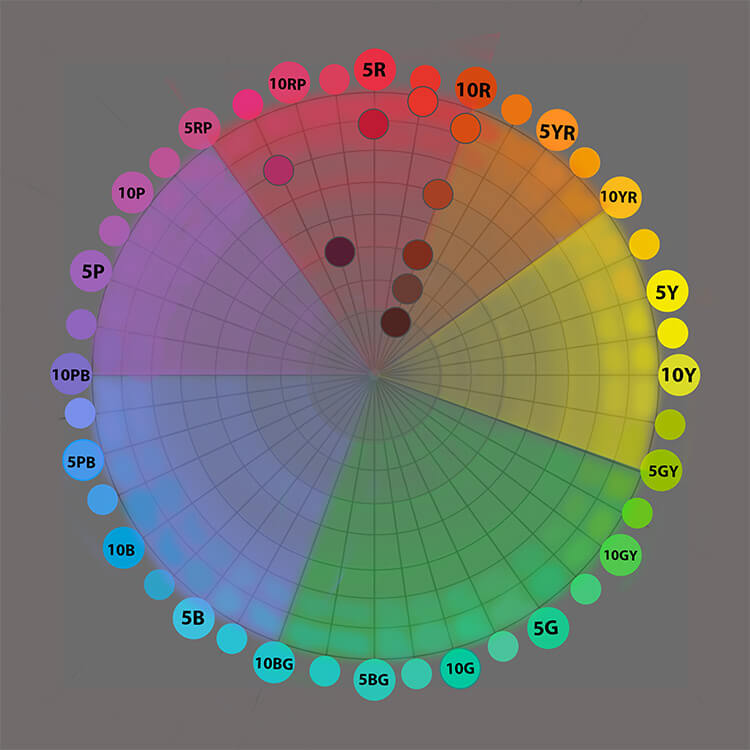
Below is a selection of red pigments that I have used and still find useful. I’ve tried to organize them by their placement on the Munsell colour wheel moving in a clockwise direction from 5RP to 10R.
Some important qualifications:
It’s impossible to be precise in comparing Munsell notations for each brand of a particular hue. Manufacturers rarely describe how they measured their colourants to attain their notations.
I’ve omitted some historic red pigments that are rarely ued or ones given uncommon names for marketing.
Historic Reds: Red Ochre, Carmine, Rose Madder, Vermilion, Red Lead
Table of Contents
Munsell Colour wheel with dots showing where common red pigments can be placed.
Quinacridone Red
Pigment Number: PV19
Munsell Notations by Brand
Gamblin: 7.5RP 4/12 (Gamblin also offers a Quinacridone Violet (2.5RP 2/8) and a Quinacridone Magenta (PR 122, 5RP 3/10)
Williamsburg: 7.5R 3/12
Michael Harding: (Quinacridone Rose Organic) 7.5R 3/10
Opacity Rating: Transparent
Tinting Strength
Oil-To-Pigment Ratio
Quinacridone Red as a pigment was first introduced by DuPont in 1958, and Winsor & Newton offered the first version for artists. As a pigment, Quinacridone Red is admired for a number of its properties:
transparency
high tinting strength
excellent lightfastness and permanence
This last quality has helped make quinacridone red a reliable alternative to alizarin crimson.
Cadmium Red (PR 108) is the primary red found on most colour wheels. It’s prized for its high chroma, high tinting strength and strong covering power.
Some manufacturers offer deep, medium and light versions. The deep version is closer to a shade of maroon while the medium and light versions lean toward orange.
Pigment Through the Ages: Cadmium Red. “It has very high hiding power and good permanence. A cadmium red was available as a commercial product from 1919. The pigment was used sparingly due to the scarcity of cadmium metal and therefore because it was more expensive.”
Naphthol Red
Pigment Number: PR112
Munsell Notations by Brand
Gamblin: 5R 4/16
Michael Harding: 7.5R 4/14
Opacity Rating: Opaque
Tinting Strength: Hight
Oil-to-Pigment Ratio: High
Lorem ipsum dolor sit amet, consectetur adipiscing elit. Ut elit tellus, luctus nec ullamcorper mattis, pulvinar dapibus leo.
Vermilion and Cadmium Vermilion
Pigment Number: PR106, PR113
Munsell Notations by Brand
Michael Harding: 5R 5/10
Rublev: 5R 5/11
Opacity Rating: Opaque
Tinting Strength: High
Oil-to-Pigment Ratio
Lorem ipsum dolor sit amet, consectetur adipiscing elit. Ut elit tellus, luctus nec ullamcorper mattis, pulvinar dapibus leo.
Pyrolle Red
PR254, PR255
Munsell Notations by Brand
Williamsburg: 10R 4/16
Opacity Rating: Semi-Transparent
Tinting Strength: High
Oil-to-Pigment Ratio: High
Lorem ipsum dolor sit amet, consectetur adipiscing elit. Ut elit tellus, luctus nec ullamcorper mattis, pulvinar dapibus leo.
Mars Red
Pigment Number: PR101
Munsell Notations by Brand
Williamsburg: 10R 3/8
Rublev: 7.5R 3/4
Old Holland: 10R 4/10
Opacity Rating: Opaque
Tinting Strength: High
Oil-to-Pigment Ratio: High
Mars Red is a synthetic red iron oxide pigment (PR101) that ranges in colour from scarlet to maroon. It’s often described as a dark brownish-red with purple undertones.
In an article on mars pigments (“Mars is Closer Than We Think”), Natural Pigments offers this background information: Mars red was introduced as a synthetic iron oxide color during the eighteenth century. Its manufacturing process started with mars yellow and then was roasted to produce a red color of various shades from russet to deep crimson. Salter writes in Field’s Chromatography of 1869 that mars red possesses ‘the richness and depth of Indian red, it is distinguished by the russet orange hue or light red.’ In an earlier edition of Chromatography, Field describes mars red as a very permanent, artificial iron ocher.
Venetian Red
Pigment Number: PR101
Munsell Notations by Brand
Gamblin: 10R 4/8
Opacity Rating: Semi-Transparent
Tinting Strength: Low
Oil-to-Pigment Ratio: Relatively Lean
Like Transparent Oxide Red, Mars Red, and Indian Red, Venetian Red is one shade of a synthetic iron oxide pigment (PR101).
When I was first learning to paint in oils, Venetian Red was the only red on my palette. The reason was that it was moderate in chroma and low in tinting strength so it wouldn’t overpower my mixes, especially in flesh.
Background Info:
A general note from a blog article, “Venetian Red: Loved by Painters, Hated by American Colonists” by Julie Snyder: “Venetian Red is derived from natural earth clay tinted by iron oxide. The deep red pigment required by painters was mined for centuries from a quarry near Venice — hence the name. Interestingly, there still remains a pit outside Venice that is claimed to be the historical source for the finest of this pigment. The name Venetian Red, however, wasn’t coined until the 17th or 18th century. It has a superlative tinting power as it’s semi-opaque. Venetian red is a red pigment with a lower chroma (less bright) than other reds, and it has a pinkish undertone, which can be seen when mixing it with white.”
From a Just Paint article: “Some Historical Pigments and Their Replacements” on Venetian Red: “Venetian Red, Sinopia, Venice Red, Turkey Red, Indian Red, Spanish Red, Pompeian Red, and Persian Red (or Persian Gulf Red, still considered the best grade for the natural pigment) are names used to describe locations where the natural red iron was extracted from the earth. Today, Red Iron Oxide is synthetically manufactured resulting in better consistency. Oxides have been used since pre-historic times and are still important pigments today. Venetian Red usually refers to a specific bluish hue of Red Oxide, but variations range from violet reds to yellowish ones.”
Indian Red
Pigment Number: PR101
Munsell Notations by Brand
Gamblin: 5R 3/6
Rublev: 10R 4/6
Opacity Rating: Opaque
Tinting Strength: High
Oil-to-Pigment Ratio: High
Lorem ipsum dolor sit amet, consectetur adipiscing elit. Ut elit tellus, luctus nec ullamcorper mattis, pulvinar dapibus leo.
Burnt Sienna
Pigment Number: PY43 and PBr7
Munsell Notations by Brand
Gamblin: 10R 3/4
Williamsburg: 2.5YR 3/6
Michael Harding: 2.5YR 3/6
Rublev: 10R 3/4 (French Burnt Sienna, PBr7 and Italian Burnt Sienna, PR102)
Old Holland: 10R 4/6
Opacity Rating: Semi-Transparent
Tinting Strength: Medium
Oil-to-Pigment Ratio: High
Burnt Sienna is tricky to summarize. The reason is that paint manufacturers market different pigments as burnt sienna and their properties vary widely.
Genuine burnt sienna is the natural reddish-brown earth pigment PY43 (and until 2021 was labelled as PBr7). It’s a natural earth iron oxide.
Synthetic burnt sienna (typically PR101 or PR102) is a synthetic iron oxide.
They are all similar in hue, chroma and value (out of the tube) but tend to differ with respect to drying times, tinting strength and opacity.
Michael Harding Paints describes their genuine burnt sienna as a very fast-drying paint, semi-transparent, with average oil content, and high tinting power.
Natural Pigments describes their Rublev brand of French burnt sienna as a semi-transparent reddish-brown with a medium tinting strength and medium drying rate.
Here’s a standard definition of burnt sienna from the Conservation and Art Materials Encyclopedia Online (CAMEO): “A dark reddish brown iron oxide pigment prepared by burning raw sienna. Burnt sienna is a permanent pigment. Named for the south Italian city of Siena that produced fine grades of the pigment, it was originally called Italian earth.”
Transparent Oxide Red
Pigment Number: PR101
Munsell Notations by Brand
Gamblin: 10R 2/4
Williamsburg: 2.5YR 1/2
Rublev: 10R 3/1
Opacity Rating: Transparent
Tinting Strength: Moderate
Oil-to-Pigment Ratio: High
Lorem ipsum dolor sit amet, consectetur adipiscing elit. Ut elit tellus, luctus nec ullamcorper mattis, pulvinar dapibus leo.